Three things standing between you
and a winning GTM strategy.
Internal Debates.
You have a great plan. CEO and board have opinions. Progress stops while everyone argues — instead of executing.
The Clock.
You need to show wins fast. Traditional research takes months and can't learn. Your client loses patience before a single campaign launches.
The Risk.
Failed launches lose clients. Until now, there was no insurance against putting your name on a plan that has no data to back it up.
The Solution
Enter the Lab.
How does Simulmatica validate B2B GTM messaging?
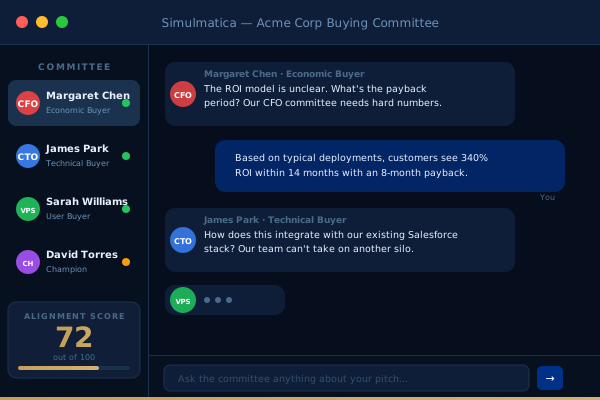
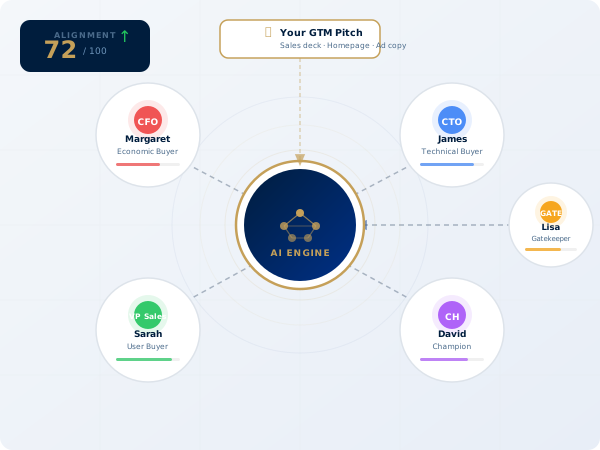
We build a digital version of your buyers. AI and real psychometric data bring your target VPs, Directors, and CFOs to life.
Give the Lab your sales decks, homepages, and ad copy. The buyers tell you exactly where they will push back. Fix your plan in the Lab before it ever faces the real market.
Test the sauce before you serve it.
Book a DemoWhat CMOs Say
This is the single best way I've seen to create and stress-test GTM messaging that will win in the marketplace.
How the Laboratory Works
Lab, created.
Give us your decks, ads, and docs. We set up a custom simulation of your client's exact B2B buying committee.
Buyers, modeled.
We build a digital version of your buyers using research-grade AI and global psychometric data.
Tests, run.
Interact with the committee. See exactly how they react to your ideas in real time.
Insights, found.
Find the wins and dangers others miss. Know what will fall flat, what will antagonize, and what will land.
GTM, ready.
Get a clear, validated Positioning Blueprint that everyone — board, CEO, sales — trusts.
The Method
Asymmetric Thinking: Why Most GTM Validation Gets It Wrong
Most B2B go-to-market validation asks buyers what they want to hear. That is the wrong question.
In a committee sale, no stakeholder tells you the real reason they said no. The CFO frames a budget objection as a timing issue. The VP of IT raises a security question when their actual concern is a threatened workflow. The economic buyer defers to a committee consensus that was decided in a hallway conversation you were not part of. The words on the surface point one direction. The decision goes another.
This is the asymmetry.
The Symmetric Trap
Traditional research is symmetric. You ask buyers what they want; they tell you what they think sounds reasonable. You build messaging around their answers. The messaging goes to market. It either works or it doesn't. When it doesn't, you commission more research.
This loop is expensive and slow. More critically, it is structurally incapable of capturing the gap between what buyers say and what buyers do. Survey responses reflect social desirability bias, not procurement reality. Focus groups surface consensus opinions, not the dissenting veto that kills a deal in the last week of a quarter. Customer interviews reveal the champion's perspective — not the CFO's unstated math. By the time traditional research identifies a problem, you have already spent the budget, launched the campaign, and put your name on a strategy the market has quietly rejected.
What Asymmetric Thinking Identifies
Simulmatica's Asymmetric Thinking framework is built on a different premise: the most important buyer signals are the ones that never appear in a survey response.
Hidden veto triggers. Every buying committee has a member whose objection will kill a deal outright — not slow it down, kill it. That person rarely speaks first. Traditional research samples the loudest voices. The Lab models every stakeholder independently, including the quiet veto.
Misaligned stakeholder assumptions. A champion inside a client organization often believes the CFO cares about growth. The CFO may be focused on cost containment. When messaging is built for growth positioning and the CFO is in cost-containment mode, the entire campaign creates friction at the exact moment it needs to create alignment.
Category confusion signals. In complex B2B sectors — SaaS, FinTech, Healthcare Technology — buyers apply mental models from adjacent categories that do not fit your offer. They hear "AI-powered" and assume experimental and unproven. They hear "simulation" and think prototype rather than research-grade methodology. Identifying category confusion before launch lets you preempt it. Missing it means prospects are comparing you to the wrong competitors.
Political landmines. Committee decisions are not purely rational. A VP whose team was recently restructured may be hostile to any initiative that expands the CMO's mandate. A Technical Buyer whose previous vendor relationship failed may impose evaluation criteria designed to surface a specific weakness. These dynamics are inaccessible through product research. They require stakeholder modeling.
Why This Changes the Economics of GTM
When you can identify these signals before launch, the economics of B2B marketing change fundamentally. A campaign that spends budget to discover that CFO messaging is wrong has generated a negative return, plus the cost of the strategy reset. A lab engagement that identifies the same misalignment in five days — before a dollar goes to media — has changed the entire risk profile of the launch.
For a Fractional CMO operating on a trust-based client relationship, the difference between “the campaign failed” and “we validated before we launched and caught the risk in advance” is the difference between losing the engagement and extending it.
Asymmetric Thinking is not a clever framework name. It is the operating logic behind why early validation produces better outcomes than late correction — and why the data that matters most is the data buyers will never give you unless you know exactly how to look for it.
Book a DemoFrequently Asked Questions
Does my Lab get smarter?
Yes. The Lab's "buyers" learn, continuously updated by you and the internet. Traditional research can't do that.
Does this replace my team?
No. It makes your team better. It tells them what will work, what will fall flat, and what will antagonize specific buyers — before anyone spends budget.
What can the Lab test?
Upload anything a buyer would read, see, or listen to — sales decks, homepage copy, ad creative, email sequences, pitch scripts.
Is my data safe?
Yes. Your data stays private with enterprise-grade security. It is never used to train public LLMs. We never share your work with others.
How is Simulmatica different from Wynter?
Wynter tests your messages with a real panel of 70,000+ LinkedIn-verified B2B professionals — you get clarity and resonance scores in under 48 hours. It's built for validating copy before a campaign launches. Simulmatica simulates the buying committee of a specific active deal — complete with role-based personas, deal-stage dynamics, and live competitive context. Wynter tells you if your message lands. Simulmatica tells you if your strategy wins the room. See the full comparison →
How is Simulmatica different from Evidenza?
Evidenza is a market research platform — it answers “who is my buyer?” through synthetic surveys and segmentation, built for enterprise teams with multi-week research timelines. Simulmatica is a buyer committee intelligence platform — it answers “will my strategy work on this company or type of company?” through live simulation, built for practitioners running active client engagements. Same AI foundation, different job to be done. See the full comparison →